
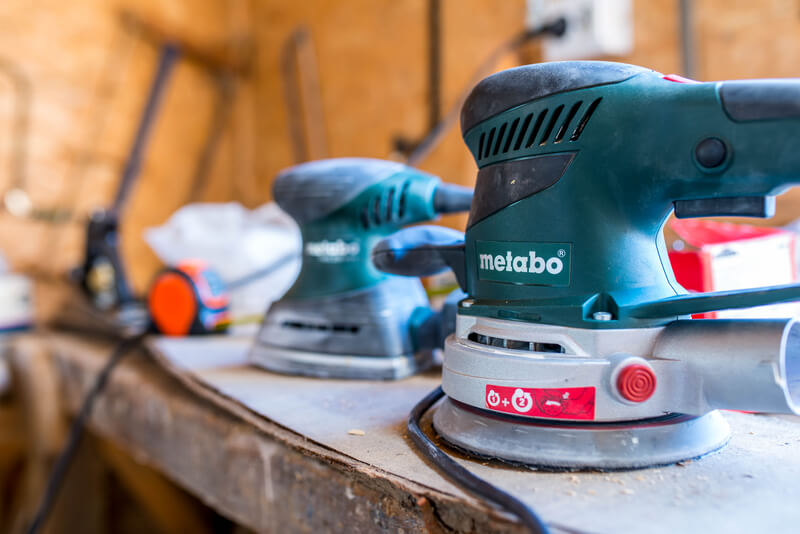
The right sander depends on the room and what you’re sanding. For open floors in living rooms and bedrooms, a drum or belt floor sander does the heavy work, paired with an edging sander for the perimeter.
- For stairs and tight spaces, an edging or detail sander is better.
- For parquet and delicate floors, an orbital floor sander avoids gouging.
- Furniture and trim call for a smaller detail or orbital sander.
Walk into any tool hire shop, and you’ll find a wall of sanders, each one designed for a slightly different job. Pick the wrong one, and you’ll either spend far longer than you need to or risk damaging the surface you’re trying to restore. Pick the right one, and a daunting project becomes a manageable weekend’s work.
The simplest way to choose is to think room by room, because the surface, the size of the area and the access all change from one space to the next.
Living rooms and bedrooms: large open floors
These are the rooms where floor restoration projects usually start, and they share the same characteristic, that is, a large, open expanse of floorboards with relatively few obstacles. That calls for a machine built to cover ground.
Best tool: drum or belt floor sander, plus an edging sander
A drum sander or a belt sander is the workhorse for open hardwood and softwood floors. It carries a rotating drum wrapped in abrasive that strips old finish and levels the surface quickly across a wide area. It’s the most efficient way to sand a large room, and it’s exactly the kind of high-volume project these machines are designed for.
Because the drum sander can’t reach the last few centimetres against the skirting, you pair it with an edging sander to finish the perimeter. The two machines together cover the whole floor: the drum for the field, the edger for the edges.
Hallways, landings and stairs: tight, awkward spaces
Hallways carry the most foot traffic in the house, so their floors often need attention first, but they’re narrow, and stairs add a vertical dimension that a large floor sander simply can’t handle.
Best tool: edging sander for hall floors, detail sander for stairs
For a narrow hallway floor, an edging sander is often more practical than a full drum sander; it’s smaller, easier to manoeuvre in a confined space, and reaches into the corners that matter most in a tight room.
Stairs are a job of their own. Each tread, riser and nosing has to be sanded individually, and no large machine can reach them. A detail sander will be the best way to sand stairs with a pointed pad that gets into corners is the right tool.
Kitchens and dining rooms: durable floors and trim
Kitchen and dining-room floors take spills, scuffs and heavy use, so they’re frequent candidates for restoration. The floor itself is sanded the same way as any other open floor: a drum sander for the main area, an edging sander for the perimeter.
Where kitchens differ is the joinery. If you’re refreshing the wooden trim, skirting or a built-in unit at the same time as the floor, those call for a smaller machine, an orbital or detail sander, to avoid damaging the finer surfaces.
Match the machine to the surface: the big sander for the floor, a small one for the detail work.
Parquet and patterned floors: delicate work
Parquet and other patterned floors are laid in blocks running in multiple directions. That’s the problem: a drum sander only moves in one direction at a time, so it inevitably cuts against the grain of half the blocks, leaving scratches that show badly under a finish.
Best tool: orbital floor sander
An orbital floor sander is the right choice for parquet and patterned floors. Rather than a single rotating drum, it uses a sanding action that works in all directions at once, so it doesn’t fight the changing grain of the blocks.
It’s also gentler, which matters on older parquet where the blocks may be thin or slightly loose.
Home office, workshop and furniture: smaller projects
Not every sanding job is a floor. If you’re upcycling furniture, refinishing a desk, or working on smaller wooden items, a full floor sander is far too large and aggressive.
Best tool: detail or palm sander
A detail sander has a small triangular pad that reaches into corners, around legs and along edges, ideal for chairs, shelves, small tables and similar items. A palm or orbital hand sander suits flatter surfaces like a tabletop or door. Both are light, controllable and well-suited to detailed work.
Which sander for which space
| Room/surface | Recommended sander | Why |
| Living room/bedroom floor | Drum sander + edging sander | Covers large open floors efficiently |
| Hallway floor | Edging sander | Manoeuvrable in narrow spaces |
| Stairs | Detail sander | Reaches treads, risers and corners |
| Kitchen/dining floor | Drum + edging sander | Same as open floors; small sander for trim |
| Parquet / patterned floor | Orbital floor sander | Works in all directions, won’t gouge blocks |
| Furniture / small items | Detail or palm sander | Light and precise for fine work |
| Decking (outdoor) | Orbital floor sander | Even finish on flat boards |
Not sure which machine your project needs?
Choosing the right sander is the difference between a smooth result and a damaged floor. We hire drum, orbital, edging and detail sanders across London, and we’ll help you match the machine to your room.
Browse our floor sander hire range
The main types of sander explained
If you’d like a fuller picture of the machines themselves, here’s how the main types differ. Our overview of the different types of floor sanders and their uses expands on this.
- Drum/belt floor sander: the most powerful floor machine, for stripping and levelling large solid-timber floors. Fast but unforgiving, best in experienced or careful hands.
- Orbital floor sander: gentler and more forgiving, working in all directions. Ideal for parquet, engineered, delicate or thinner floors, and for light sanding between coats.
- Edging sander: a smaller machine for the perimeter of a room and other spots that the main sander can’t reach. Almost always hired alongside a drum sander.
- Belt sander (handheld): aggressive material removal for heavy timber, levelling and shaping, more of a workshop tool than a floor machine.
Hiring the right sander rather than buying
Floor sanders are specialist machines. A professional-grade drum or orbital sander costs hundreds of pounds to buy and needs proper storage and maintenance, a poor investment for a project you’ll do once every several years.
Hiring gives you the correct, well-maintained machine for the days you actually need it, often with the abrasives and accessories included.
If your project spans more than one type of space, say, a living room floor and a staircase, it’s worth hiring a combination. Our sander packages bundle the machines and consumables a typical job needs.
Common mistakes when choosing a sander
Most sanding problems trace back to the wrong machine, not poor technique. A few mistakes come up again and again:
- Using a drum sander on parquet or delicate floors. The single most common error gouges across the changing grain and leaves scratches that show through the finish. Use an orbital instead.
- Trying to sand stairs with a floor machine. It can’t reach the treads and risers safely. Stairs always need a detail sander.
- Forgetting the edging sander. A drum sander leaves an unsanded border against the skirting. Without an edger, you’re left with a visible strip around the whole room.
- Over-sanding with too coarse a grit. Starting too aggressively removes more timber than necessary. Work up through the grits, coarse to remove the old finish, finer to smooth, rather than forcing one harsh pass.
- Choosing a machine that’s too big for the space. A full drum sander in a small hallway or bathroom is hard to control and easy to gouge with. Match the machine to the size of the room.
Choosing with confidence
The right sander is rarely a single ‘best’ machine; it’s the one that matches your room, your surface and your project.
Large open floors want a drum sander and an edger; stairs and detail work want a smaller machine; parquet and delicate floors want an orbital. Get that match right, and the job goes smoothly.
We hire the full range across London and can advise on exactly what your project needs. Browse our floor sander hire range, explore our sander packages, or get in touch, and we’ll point you to the right machine for the room.