
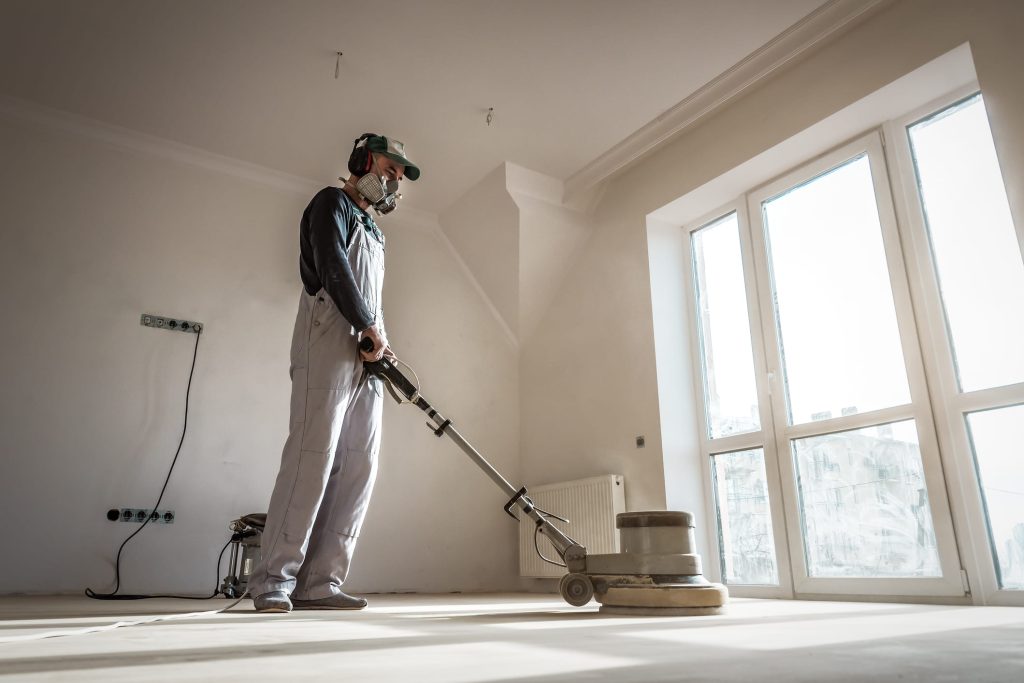
A wooden floor can look dry long before it is ready to sand. After a leak, flood or damp problem, resolve the moisture source, test several parts of the floor, compare affected boards with normally dry areas, and make sure readings and board movement have stabilised. Sanding a floor while the timber is still drying can leave an uneven result once the wood changes shape again.
Can You Sand a Floor After a Leak or Damp?
Often, yes. Water exposure does not automatically mean a wooden floor needs replacing, but sanding is a restoration step, not a drying method.
Before sanding floorboards after a leak, make sure the leak or damp source has been dealt with. Then assess whether the timber is returning towards its normal moisture condition and whether boards are still cupping, swelling or buckling. If readings are still changing materially, wait.
Why a Floor Can Look Dry but Still Be Too Wet to Sand
The exposed face of a floorboard can dry faster than the timber beneath it. Water can also pass through joints and remain in a timber subfloor, screed or concrete base after the visible surface has dried. Flooring-industry guidance specifically warns that a floor can appear dry at the surface while moisture remains deeper in the flooring or subfloor.
Wood is hygroscopic, so it absorbs and releases moisture as surrounding relative humidity changes. As its moisture content changes, boards can expand, shrink or distort. If a moisture-distorted floor is flattened too early, more timber may be removed from raised areas than is sensible.
What Moisture Level Should a Wooden Floor Be Before Sanding?
Around 6 – 9% moisture content is commonly cited for interior wood flooring in normal indoor conditions, but it is not a universal “safe to sand” number. The appropriate level depends on timber species, temperature, relative humidity and the property’s normal conditions. Current Protimeter guidance describes 6 – 9% as a typical flooring range while stressing that acceptable moisture depends on the material and environment.
Equilibrium moisture content (EMC) is the moisture level wood tends towards when it is in balance with the surrounding air. This is why one percentage cannot be applied to every house or floor.
After a leak, compare the affected area with similar boards that were not wet. A single percentage tells you less than a pattern showing the affected section returning towards the floor’s normal baseline.
How to Test a Wooden Floor Before Sanding
Use a moisture meter designed for wood and test more than one location. The goal is to understand the pattern across the floor, not find one favourable reading.
- Test the original leak or wettest known area.
- Check surrounding boards and the edge of the affected zone.
- Take readings from several unaffected boards for comparison.
- Test an accessible timber subfloor where relevant.
- Record the readings and repeat them later under similar room conditions where practical.
One measurement describes the floor at one moment. Repeated measurements help show whether its moisture condition is still changing.
Pin vs Pinless Moisture Meters
Pin-type meters take readings at specific points in timber. Correct species settings and probe technique matter. Pinless meters are useful for quickly scanning a wider area and locating wetter zones without puncturing the floor, although material, depth and construction can influence the reading.
A practical approach is to use a pinless meter to map suspect areas and a pin-type meter where a quantitative wood moisture reading is needed. Protimeter similarly describes non-invasive meters as useful for locating areas that warrant further investigation and pin meters for quantitative timber readings.
Do You Need to Check the Subfloor?
After a substantial leak, the subfloor can remain wetter than the visible floor. Where a timber subfloor is accessible, compatible wood-moisture testing can help establish whether moisture remains below the boards.
Concrete and screed need different interpretations. A timber moisture-content percentage should not be treated as a concrete relative-humidity reading. Flooring moisture guidance distinguishes pin-type testing of timber from hygrometer-based testing of concrete slabs.
How Can You Tell Whether the Floor Is Still Drying?
A floor is likely still changing if readings continue to fall, the wet area remains noticeably different from unaffected boards, cupping or swelling is still changing, or the subfloor remains damp. A persistent musty smell or unresolved leak also warrants investigation.
Visible signs are useful clues, but they do not replace testing.
| What you find | What it suggests | What to do |
| Readings stable and close to normal comparison areas | Moisture may have stabilised | Assess the floor for sanding |
| Readings still falling | Drying is continuing | Wait and retest |
| Affected boards remain noticeably wetter | Residual moisture may remain | Continue drying or investigate |
| Cupping or swelling is still changing | Boards remain unstable | Do not sand flat yet |
| Subfloor remains damp | Moisture remains below | Address the substrate first |
| Rot, mould, severe buckling or delamination | Possible material failure | Seek appropriate professional assessment |
Readiness comes from several pieces of evidence agreeing, not from one moisture-meter number.
Can You Sand Cupped or Warped Floorboards?
Do not immediately sand a cupped floor flat while the distortion is still moisture-related. Cupping means the edges of a board sit higher than its centre.
If those raised edges are sanded away before the floor stabilises, the board can change profile again as it dries. The centre may then sit comparatively higher than the edges, creating crowning. Current industry guidance specifically warns that sanding a moisture-cupped floor before it returns to equilibrium can produce this result.
How Long Should a Wooden Floor Dry Before Sanding?
There is no dependable universal waiting period. Drying time depends on the amount of water, exposure time, board thickness, floor construction, subfloor, ventilation, temperature and relative humidity.
Moisture readings are more useful than counting days. If readings are still changing materially, the floor has not reached a stable moisture condition.
Flooring-industry guidance similarly treats post-flood readiness as a moisture-condition question rather than simply a question of elapsed time.
What to Check Before You Start Sanding the Floor
Once moisture has stabilised, check that the leak or damp source is resolved, the boards are secure, significant rot or delamination has been assessed, protruding fixings have been dealt with, and the floor construction is suitable for sanding.
Engineered wood needs particular care. Unlike solid timber, it has a finite real-wood wear layer. Delamination or too little remaining wear layer can make further sanding unsuitable. Floor Sanders London’s engineered-floor guidance likewise identifies wear-layer thickness and current condition as key limits on refinishing.
Choosing a Sander Once the Floor Is Ready
Only choose sanding equipment after the moisture and condition checks are complete.
At Floor Sanders London, we hire professional floor sanding equipment for domestic and commercial projects, including belt, edging, Trio, corner and orbital sanders.
A heavily worn solid timber floor may need a different approach from parquet, engineered boards or a floor that only needs fine finishing. If you are unsure which machine suits the job, check the floor type, condition and room before starting. Floor Sanders London’s current machine guide differentiates equipment according to room size, surface and floor construction.
When Should You Not Start Sanding?
Do not begin sanding if there is an active leak, unexplained damp, changing moisture readings, a wet subfloor, active cupping or swelling, significant mould or rot, severe buckling, delamination or uncertainty over whether an engineered floor has enough wear layer remaining.
Hire Floor Sanding Equipment from Floor Sanders London
If your floor is dry, stable and suitable for sanding, Floor Sanders London can help you choose the right equipment for the next stage. Tell us what type of wooden floor you are sanding and its condition so we can help identify an appropriate machine or package.
Call us on 0208 427 6604 or contact us to discuss your floor sanding project.
Ready to arrange your hire? Compare our sander packages and choose the equipment that suits your project.
Frequently Asked Questions
Does the Type of Wood Affect Moisture-Meter Readings?
Yes. Wood species can influence readings because density and other properties vary. If a pin-type meter has species settings or correction tables, use the setting recommended for the timber being tested, especially when relying on an absolute moisture-content figure. Protimeter notes that species-specific calibration can improve the accuracy of quantitative wood-moisture readings.
Can Sanding Remove Water Stains After the Floor Has Dried?
Sometimes. Shallow staining may be reduced by sanding once the timber is dry and stable, but deeper water penetration can leave discolouration below the amount of wood it is sensible to remove. Do not keep sanding deeper simply to chase a stain.
Can You Sand Only the Water-Damaged Part of a Wooden Floor?
Sometimes. A locally sanded section may look different from the surrounding aged floor after finishing. Once the moisture problem is resolved, the choice between a local repair and refinishing a wider area becomes an appearance decision partly. Floor Sanders London’s guidance on resanding existing floors makes the same distinction: a damaged area can sometimes be treated locally, but the finished section may not visually match the surrounding floor.
Does Underfloor Heating Affect a Wooden Floor After a Leak?
Yes. Underfloor heating can increase moisture differences through a wood-floor construction and drive additional drying. Do not turn the system up aggressively as a shortcut. Restore controlled conditions and follow the flooring and heating-system manufacturer’s guidance.
Can the Top of a Floor Be Dry While Underneath Is Still Damp?
Yes. Moisture can remain within boards or the subfloor after the exposed surface has dried. Post-leak testing should therefore consider both the affected boards and the construction beneath them where practical.