
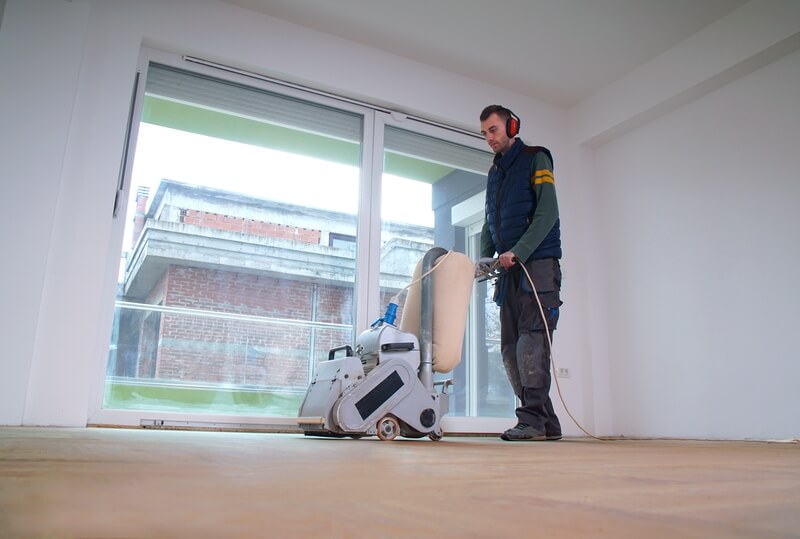
You’ve pulled up an old carpet in a Victorian terrace and found original floorboards beneath it. They look tired, but promising. The problem is that you have no idea whether they were sanded ten years ago, fifty years ago or several times before you moved in.
So, can you safely sand them again?
Here’s the honest answer: it depends. Solid wooden floors can often be sanded several times, but the safe limit depends on how thick the timber is, how much timber previous sanding has removed and whether the floor is still structurally sound. Historic floorboards may already be thinner than expected, so they need particular care.
What determines how many times a floor can be sanded?
Every proper sanding removes part of the wooden surface. How much is removed will depend on the floor’s condition, the equipment used and how aggressively the work is carried out.
A lightly worn floor that only needs its old coating removed is very different from an uneven floor covered in deep marks, paint or heavy varnish. A badly marked or uneven floor may need more levelling, which usually means removing more timber.
Before sanding a wooden floor, consider four things:
- What type of floor is it?
- Has it clearly been sanded before?
- How much usable timber remains?
- Are there structural problems beneath the worn surface?
Old coatings, loose boards, rot, warping and insect damage should also be identified before work begins. Loose or missing boards need attention before sanding, rather than being treated as surface imperfections.
How Floor Type Affects How Many Times It Can Be Sanded
Solid wooden floorboards
Solid floorboards generally provide more scope for repeated wooden floor sanding because the board is timber throughout. That does not mean every solid floor is automatically safe to sand again.
Original floorboards in older properties may be worn, uneven or thinner after earlier restoration work. Solid floors can often be sanded several times, but older boards may already have lost material through wear or previous restoration work.
The floor’s age alone won’t give you the answer. An old floor that has been treated gently may have more usable timber than a newer one that was aggressively levelled during an earlier renovation.
Engineered wooden flooring
Engineered flooring has a timber wear layer over its underlying construction. If that layer is already thin or has been sanded before, an aggressive pass can damage it permanently.
There is no single sanding limit that applies to every engineered floor. Its suitability depends on the depth of the remaining wear layer and whether it has been sanded before.
You need to identify the floor’s construction and assess the remaining surface before starting.
When its specification and previous sanding history are unknown, guessing could permanently damage the floor.
Parquet flooring
Solid parquet blocks may be suitable for sanding more than once, but you still need to inspect their thickness and stability. A loose block or doorway threshold may give you a clearer view of the parquet’s remaining depth before you commit to sanding the whole room.
Previously sanded blocks may have very little usable timber left before their joints or edges become vulnerable. Loose blocks, complex patterns, adhesive contamination and structural concerns all make the work more demanding.
How to preserve the floor during sanding
The aim should be to remove only what is necessary to prepare an even surface.
Preparation matters. Secure loose boards, remove exposed nails or staples and deal with damaged areas before the sanding machine touches the floor. During the work, keep the machine under control and avoid repeatedly sanding one problem area in an attempt to remove every deep mark.
Work through the abrasives gradually, keep the machine moving and take a lighter approach with older or delicate boards. Floorboards and parquet also need different sanding techniques, so do not treat every wooden floor in the same way.
Can you sand the floor yourself?
Yes, but only when the floor is in relatively good condition and you are confident using the appropriate equipment. DIY restoration becomes considerably riskier when the floor is severely damaged, historically important, unusually thin or structurally unstable.
When the floor type or remaining thickness is uncertain, ask for advice before starting. Once you remove too much timber, you cannot put it back.
So, Can Your Wooden Floor Be Sanded Again?
A wooden floor may be sanded several times during its life, but there is no safe universal figure. The answer depends on its construction, remaining thickness, condition and previous treatment.
Inspect first. Sand cautiously. And do not assume that a solid-looking surface means there is plenty of material underneath.
Once you know that your floor is suitable, browse our professional floor sanders, read our practical floor-sanding tips or contact the team for straightforward guidance on your project.
FAQs
Does sanding remove a lot of wood?
It depends on the floor’s condition, the abrasive used and how heavily it is sanded. The aim is to remove only what is necessary.
Can you sand only one damaged area of a wooden floor?
You can, but the repaired area may look different from the surrounding floor once the finish is applied.
Is sanding or replacing a wooden floor better?
It depends on the floor’s condition and remaining thickness. A sound floor may be suitable for sanding, while badly damaged or unstable boards may need replacing.
Can painted floorboards be sanded again?
Possibly. Check the boards for damage, loose areas and remaining thickness before sanding through the paint.
Should deep scratches always be sanded out completely?
No. Removing every deep scratch may take off more timber than is sensible. Preserving the floor is more important than achieving a flawless surface.